A founder checks the website dashboard on Monday morning.
Traffic is down again.
The marketing team says rankings are still stable. Some keywords are even moving up. But fewer people are clicking. Fewer demo forms are coming in. Sales is asking where the leads went.
Then someone in the team drops three new terms in the meeting.
SEO. GEO. AEO.
Now the founder has a new problem.
Not just “How do we get more leads?” but “Are we investing in the wrong search strategy?”
This is where many AI businesses, SaaS startups, automation agencies, and service firms are stuck right now. They know search is changing. They know buyers are using Google, ChatGPT, Perplexity, Gemini, Copilot, and voice assistants differently. But they do not know what actually deserves budget.
Here is the truth.
Traditional SEO is not dead in 2026. Bad SEO is dead.
Google’s own 2026 guidance says SEO is still relevant for generative AI search because AI Overviews and AI Mode are rooted in core Search ranking and quality systems. Google also explains that its AI search uses techniques like retrieval augmented generation and query fan out to pull useful, current information from indexed web pages.
So the question is not SEO vs GEO vs AEO.
The real question is simpler.
How do you make your business easy to find, easy to understand, easy to trust, and easy to cite?
That is what matters now.
What is SEO?
SEO means search engine optimization.
In plain language, SEO helps your pages show up when people search on Google or Bing.
For an AI service business, this could mean ranking for searches like:
AI automation agency
AI chatbot development company
AI consulting services for business
custom AI agents for operations
AI search optimization services
outsourced SEO and GEO management
SEO still matters because buyers still search before they buy. They compare options. They read service pages. They check case studies. They look for proof.
A strong SEO strategy includes clear service pages, fast website speed, crawlable pages, internal links, helpful content, technical fixes, backlinks, and content that answers real buyer questions.
Without this base, GEO and AEO become decoration.
You cannot get cited by AI systems if your website is unclear, thin, blocked, outdated, or full of generic content.
What is AEO?
AEO means answer engine optimization.
It is the practice of making your content easy to use as a direct answer.
Think of short, clear answers inside FAQs, comparison pages, glossary pages, local service pages, and how to guides.
AEO matters because buyers often ask full questions now.
Not just “AI agency.”
They ask:
What is the best AI automation agency for a small business?
How much does it cost to build an AI chatbot?
Can AI reduce customer support workload?
AEO vs SEO for local business: what should I focus on first?
AEO helps your content answer these questions in a direct way.
This supports featured snippets, People Also Ask results, voice search, AI Overviews, and other answer first experiences.
Structured data can help search engines understand page content and make pages eligible for rich results, but it is not a magic ranking button. Google says structured data must accurately represent visible page content, and even correct markup does not guarantee a rich result.
So do not treat schema as a hack.
Treat it as a clarity tool.
What is GEO?
GEO means generative engine optimization.
It focuses on helping AI platforms like ChatGPT, Perplexity, Gemini, Copilot, and Google AI Overviews mention, recommend, or cite your brand when people ask detailed questions.
Search Engine Land defines GEO as positioning your brand and content so AI platforms cite, recommend, or mention you when users search for answers. It also notes that GEO builds on SEO fundamentals but shifts attention from rankings and clicks to mentions and citations inside AI generated answers.
This is important because your future buyer may not search like this:
“AI automation agency Melbourne”
They may ask:
Compare the best AI automation companies for a 50 person service business that wants to reduce admin work, improve lead response time, and connect CRM, email, and support tools.
That is a GEO search moment.
You are not fighting for one blue link.
You are fighting to become part of the answer.
A simple example: SEO vs AEO vs GEO
Imagine a B2B SaaS company selling project management software.
A buyer searches “project management software features” on Google. Your long form blog ranks. They click, read, and visit your pricing page.
The buyer asks their phone, “What is the best project management tool for marketing agencies?” A search assistant may use a clear answer from a well structured comparison page or FAQ style section.
The buyer asks ChatGPT or Perplexity, “Compare Asana and Monday.com for a 50 person remote team. Include pricing, integrations, setup effort, and user experience.” The AI tool builds a custom answer from many sources.
Your brand wins only if the web already contains clear, consistent, trusted information about your product.
That means your website, reviews, comparison pages, third party mentions, customer proof, documentation, and case studies all matter.
This is why GEO is not only a content job.
It is a brand clarity job.
Is traditional SEO dead in 2026?
No.
But the lazy version is dying.
Publishing 20 generic blogs per month will not save you. Rewriting the same “what is AI automation” article as every competitor will not save you. Stuffing keywords like generative engine optimization agency or AI search optimization services into weak pages will not save you.
Google’s helpful content guidance says its systems are designed to prioritize helpful, reliable, people first content, not content made mainly to manipulate rankings. Google’s AI content guidance also says quality matters more than whether content is produced by AI or humans, with emphasis on experience, expertise, authoritativeness, and trustworthiness.
That means your content needs to prove you know the problem.
For an AI business, that means showing:
What workflow you improved
What tools you integrated
What the process looked like before and after
What result the client got
What mistakes buyers should avoid
What budget range is realistic
What timeline is normal
What is not worth automating yet
That is the type of content both humans and AI systems can trust.
The real impact of AI Overviews on organic traffic
This is the uncomfortable part.
AI search can reduce clicks.
Ahrefs reported in February 2026 that the presence of a Google AI Overview correlated with a 58 percent lower average click through rate for the top ranking page.
A 2026 academic study on Google AI Overviews and Wikipedia found that exposure to AI Overviews reduced daily traffic to English Wikipedia articles by about 15 percent across matched article language pairs.
So yes, the impact of AI Overviews on organic traffic is real.
But the wrong conclusion is “SEO is useless.”
The better conclusion is this:
Clicks are no longer the only sign of visibility.
Your brand can influence a buyer before they ever visit your website. They may see you in an AI answer today, search your name tomorrow, visit your LinkedIn next week, and book a call later.
That makes measurement harder.
Not less important.
What matters most in AI SEO now?
If you have limited budget, do not chase every acronym.
Prioritize in this order.
1. Fix your SEO foundation first
Make sure your website can be crawled and indexed.
Create clear service pages for your main offers. For example:
AI automation services
AI chatbot development
AI agents for business operations
AI search optimization services
generative engine optimization agency
outsourced SEO and GEO management
Each page should explain who it is for, what problem it solves, what you actually do, what tools you use, what results are realistic, and how someone can start.
No vague “we transform businesses with AI” language.
That is lazy.
2. Build answer ready content
Turn buyer questions into clear sections.
Use headings that match real search behavior:
How to optimize website for AI search
How to rank in LLM answers
What is generative engine optimization?
GEO vs AEO examples
AEO vs SEO for local business
Search optimization strategy for startups
Answer each question simply first.
Then explain.
This helps readers, Google, and AI tools understand the page faster.
3. Create citation worthy proof
AI systems need evidence.
Buyers need evidence too.
Publish case studies, comparison pages, benchmarks, customer stories, process breakdowns, implementation guides, pricing explainers, and expert commentary.
Do not hide all your knowledge behind calls.
If your website says nothing useful, AI systems have nothing useful to cite.
4. Build off site trust
GEO is not only your website.
Search Engine Land notes that earned mentions from reviews, journalists, communities, and third party sources help AI systems interpret credibility.
So get visible in places buyers and AI systems can see.
Your brand should mean the same thing everywhere.
If your site says “AI automation,” your LinkedIn says “growth agency,” and your case studies say “software development,” you are creating confusion.
Confusion kills citations.
Confusion also kills sales.
5. Track AI visibility separately
Your old dashboard will not show the full journey.
Bing Webmaster Tools introduced AI Performance reporting in 2026 to show how often publisher content is cited in AI generated answers, which URLs are referenced, and how citation activity changes over time. Microsoft also expanded AI visibility insights with intents, topics, citation share, and compare features in June 2026.
This tells you where measurement is going.
Rankings still matter.
Traffic still matters.
Conversions still matter.
But AI citations, brand mentions, share of voice, and prompt visibility now matter too.
So where should your budget go?
Here is the practical answer.
If your website has weak service pages, poor technical SEO, no case studies, and generic blogs, spend 70 percent of your effort on SEO foundation.
If your site already ranks but traffic is softening, spend more effort on AEO and GEO.
If you are a startup with no authority, do not pretend GEO will magically fix it. Build topical authority first. Publish useful pages. Earn mentions. Show proof. Be specific.
For most AI businesses, the right search optimization strategy for startups looks like this:
The mistake is treating them as separate departments.
They are not.
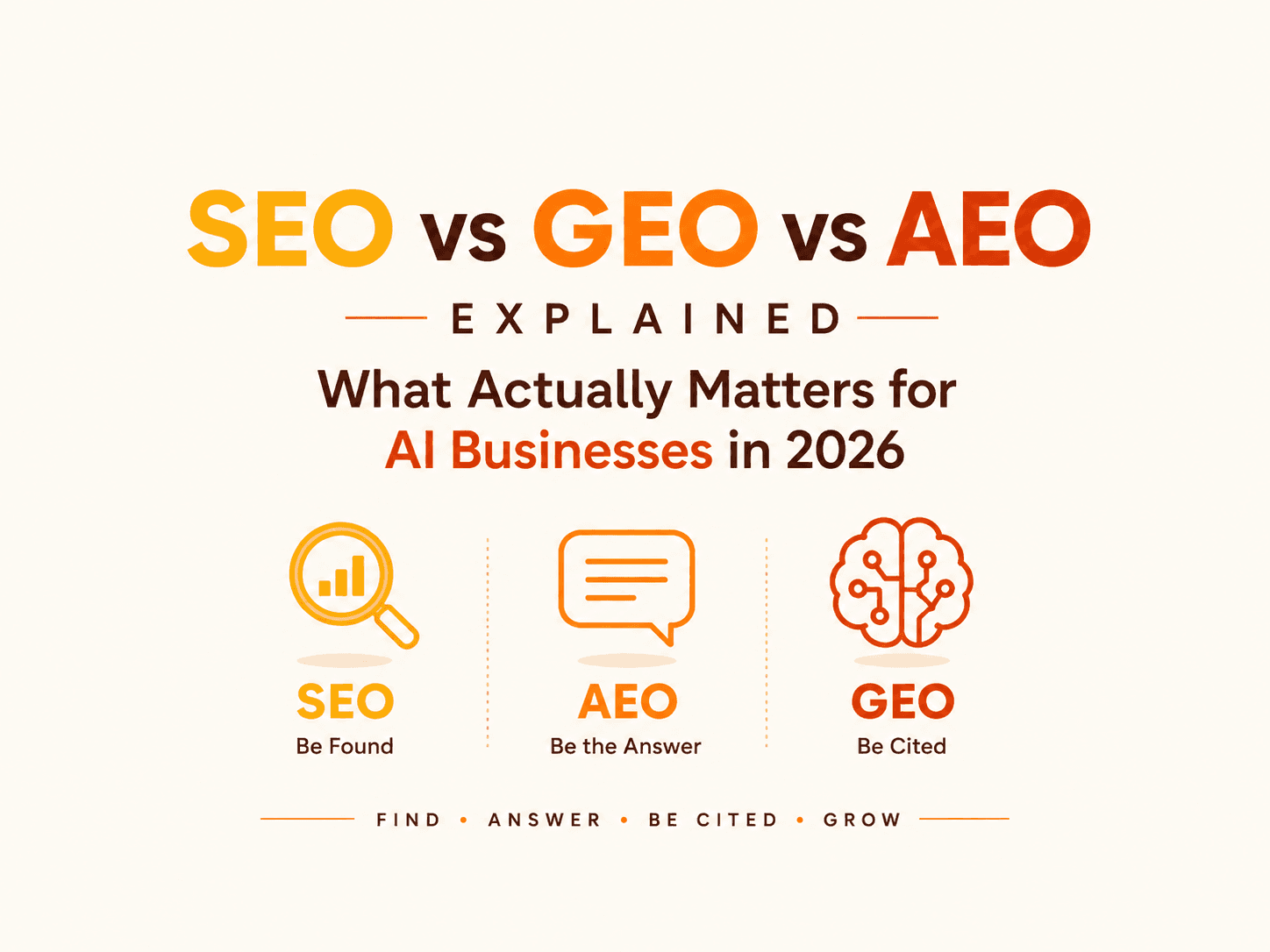
They are three layers of the same visibility system.
Final takeaway
SEO vs GEO vs AEO is the wrong fight.
The real fight is clarity vs invisibility.
Your buyer is already asking better questions. Google is already giving more direct answers. AI tools are already shaping shortlists before your sales team knows the buyer exists.
So your job is not to chase buzzwords.
Your job is to make your expertise impossible to misunderstand.
Build pages that rank.
Write answers that help.
Publish proof that earns trust.
Create brand signals AI systems can recognize.
That is how to optimize a website for AI search in 2026.
Not by abandoning SEO.
By finally doing it properly.