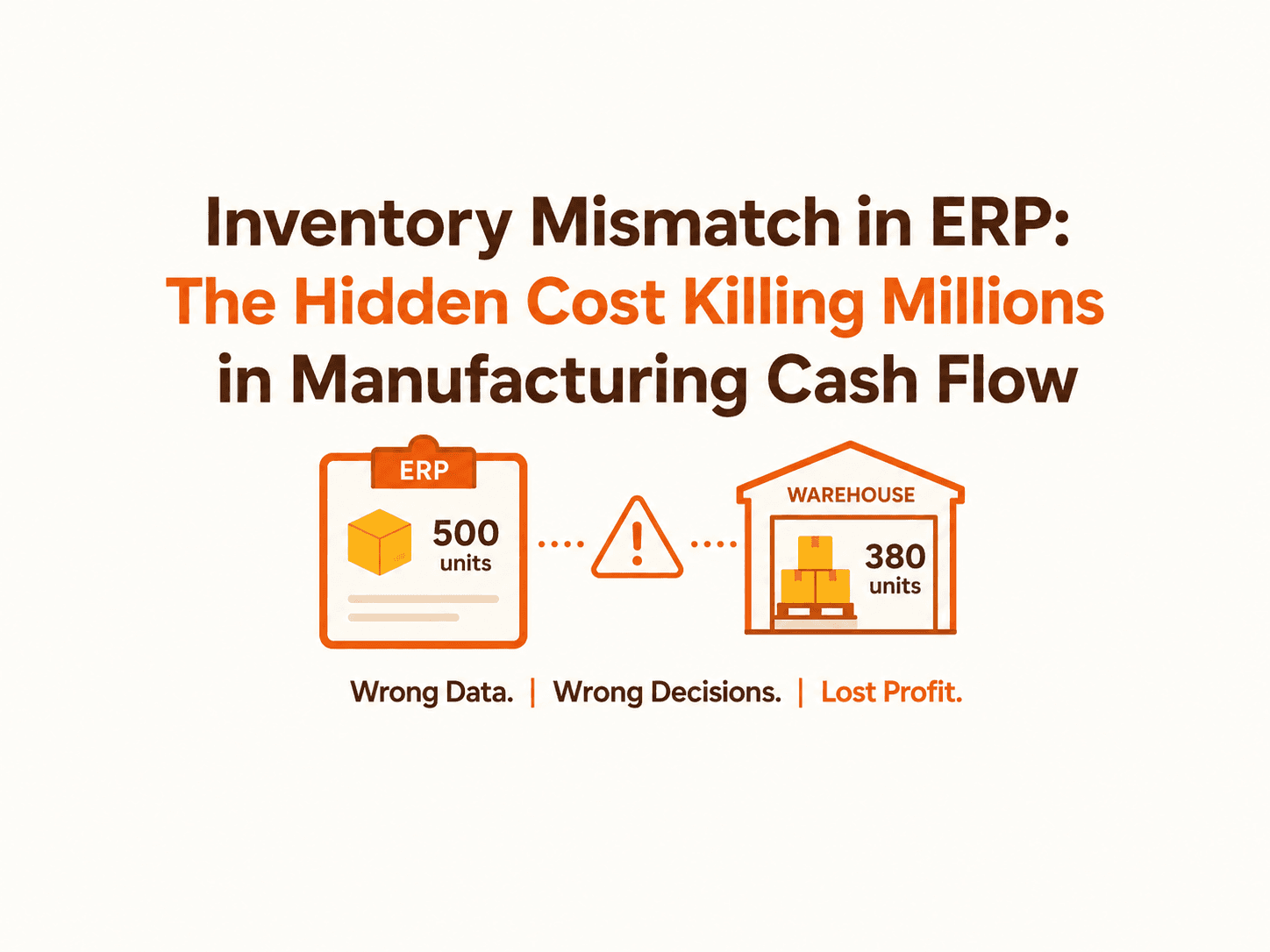
Your ERP says the material is available.
So the production plan is approved.
Purchasing moves on. Sales confirms the delivery date. Finance trusts the numbers. The customer expects the order on time.
Then someone from the floor calls.
“We do not have enough stock.”
Now the whole business stops for one small mismatch.
The team searches the warehouse. Someone checks old purchase entries. Someone calls the supplier. Someone asks production to wait. Someone tells the customer there may be a delay.
Nothing looks dramatic on the dashboard.
But money is already leaking.
That is the hidden danger of inventory mismatch in ERP. It does not always look like a big failure. It looks like small confusion repeated every day until it becomes lost revenue, urgent buying, idle labor, delayed dispatch, excess inventory, and angry customers.
What inventory mismatch really means
Inventory mismatch happens when your system stock does not match your physical stock.
In simple words, your ERP says one thing. Your warehouse says another.
Your system may show 500 units of a raw material, but only 380 are physically available. Or it may show zero stock while the material is actually sitting in the wrong location. In both cases, the business makes decisions using wrong information.
That is why inventory not matching physical stock is not just a warehouse issue. It is a business control issue.
Inventory accuracy affects planning, ordering, stock keeping, fulfillment, accounting, and supply chain visibility. ISM explains that inventory accuracy is measured by comparing counted stock keeping units with units on record, and accurate stock data helps reduce shrinkage, support accounting, and improve visibility. The same ISM article says 95 percent accuracy can be considered world class, while weaker companies can fall much lower.
So here is the uncomfortable truth.
If your ERP data is wrong, your decisions are wrong before the meeting even starts.
Failure mode 1: Stock mismatch in manufacturing breaks production planning
Manufacturing runs on timing.
The right material must reach the right line at the right time.
When stock mismatch in manufacturing happens, production planning becomes guesswork. Your team may schedule a batch because the ERP shows enough raw material. But when the job starts, the material is short, reserved, damaged, in quality inspection, or sitting in the wrong bin.
One small stock mismatch becomes a chain reaction.
SAP’s own inventory management learning material explains that inventory management maps physical stock in real time by recording all stock changing transactions and stock updates. It also tracks stock in unrestricted use, quality inspection, ordered stock, and stock reserved for production or customers.
That means the system is only reliable when every movement is captured properly.
Miss one goods issue. Delay one receipt. Use the wrong unit. Skip one transfer. Your ERP starts lying quietly.
Failure mode 2: Stockouts create lost sales and broken trust
A stockout in manufacturing is not just “we ran out.”
It means the business promised more than it could deliver.
The cost is not only the missing material. The cost is the whole mess around it.
You may pay premium freight. You may buy from a more expensive supplier. You may lose a delivery slot. You may lose customer trust. You may also train customers to stop believing your promised dates.
Inventory distortion is a huge problem at scale. IHL’s 2023 research, published through Blue Yonder, estimated worldwide retail inventory distortion at 1.77 trillion dollars, with out of stocks accounting for 1.2 trillion dollars and overstocks for 562 billion dollars. This is retail data, not manufacturing data, but it shows the size of damage when stock records and demand reality break apart.
In manufacturing, the same logic is even more painful because one missing component can block the sale of the full finished product.
A 5 dollar part can delay a 50,000 dollar order.
That is how inventory mismatch kills margin without looking like a major event.
Failure mode 3: Excess stock hides bad decisions
Inventory mismatch does not only cause shortages.
It also creates overbuying.
When the team does not trust the ERP, they create their own safety stock. The purchase manager orders extra. The production manager keeps buffer stock. The warehouse hides critical material “just in case.” Sales asks for more finished goods because they do not trust availability.
Everyone is trying to protect the business.
But together, they trap cash.
Inventory carrying cost is not free. ISM notes that many companies aim for inventory carrying cost between 20 and 30 percent of total inventory costs, and that this can include opportunity cost, storage, insurance, taxes, handling, shrinkage, and obsolescence.
Typical inventory carrying cost as a share of total inventory value, per ISM.
Possible yearly hidden carrying cost on $2M of unnecessary stock, at that rate.
That is before counting dead stock, damage, rework, finance cost, or warehouse space.
This is why manufacturing inventory problems are often cash flow problems wearing an operations mask.
Failure mode 4: Finance reports clean numbers from dirty data
Here is where leadership often gets fooled.
The ERP report looks structured.
The dashboard looks professional.
The monthly review looks under control.
But if the physical stock is wrong, the financial picture is also polluted.
Inventory affects working capital. It affects cost of goods sold. It affects margins. It affects purchasing decisions. It affects whether finance thinks cash is stuck or available.
A wrong inventory number can make a weak month look acceptable. It can also make a good month look worse than it is.
This is why cycle counts and physical verification are not “warehouse discipline.” They are financial control.
The real question is not, “Do we have ERP?”
The real question is, “Can the business trust the ERP enough to make expensive decisions from it?”
The hidden root cause: Your ERP records transactions, but your process creates truth
Most companies blame the software too quickly.
That is lazy thinking.
The ERP is often not the real problem.
The real problem is the gap between the physical movement and the digital record.
Material moves in the real world first. Someone receives it. Someone stores it. Someone issues it. Someone consumes it. Someone returns it. Someone adjusts it.
If that movement is not captured at the same time, with the right item code, unit, location, batch, status, and approval, the ERP becomes a delayed story, not live truth.
This is the hidden root cause of inventory mismatch in ERP:
Your business has no single trusted inventory truth.
Instead, it has ERP records, Excel sheets, warehouse memory, purchase follow ups, WhatsApp confirmations, and manual adjustments.
That is not control.
That is organized confusion.
The system fix: Build a live inventory control layer
The fix is not buying another dashboard.
A dashboard only shows the problem faster.
The real fix is a system that connects inventory movement, ERP data, warehouse actions, purchasing, production, and decision rules.
A strong inventory management software for manufacturing should do five things clearly.
It should capture every stock movement as close to real time as possible.
It should connect ERP, warehouse, production, purchasing, and sales data into one live view.
It should flag mismatches before they become production stoppages.
It should separate available stock from blocked stock, reserved stock, quality stock, damaged stock, and in transit stock.
It should use AI forecasting and exception alerts to help teams act before stockouts happen.
This is where AI services can create real value. Not by adding a chatbot. Not by adding another fancy screen. But by building a custom AI inventory intelligence layer around your actual business flow.
Microsoft’s Inventory Visibility service is a good example of the direction modern systems are taking. It supports real time on hand inventory change postings, visibility across data sources, availability checks, soft reservations, and current or next available dates across channels and systems.
AI can also improve forecasting. McKinsey reports that AI driven forecasting in supply chain management can reduce forecast errors by 20 to 50 percent, with lost sales and product unavailability reduced by up to 65 percent in relevant use cases.
Another McKinsey article from 2024 says AI in distribution operations can reduce inventory levels by 20 to 30 percent through better demand forecasting, segmentation, and inventory optimization.
Do not treat these numbers as a guaranteed promise.
Treat them as proof that better data, better forecasting, and better control can create measurable financial impact.
What business leaders should check this week
Do not start with software shopping.
Start with these questions.
How often does your ERP stock fail physical verification?
How many production delays were caused by material shortage in the last 90 days?
How much emergency purchasing did your team do because stock was not available?
How much slow moving inventory is sitting because people overbought to feel safe?
How many Excel sheets still exist because teams do not trust the ERP?
How much time does your team spend reconciling stock instead of improving operations?
If you cannot answer these questions quickly, you do not have an inventory problem.
You have a visibility problem. And visibility problems become money problems.
Conclusion: Control your stock before it controls your cash
Inventory mismatch is dangerous because it looks small.
One wrong entry.
One missed scan.
One delayed goods receipt.
One incorrect transfer.
But inside a real business, those small errors create stockouts, overstocking, production delays, wrong purchasing, weak cash flow, and poor customer experience.
The companies that win are not the ones with the most inventory.
They are the ones with the most trusted inventory truth.
If your ERP says one thing, your warehouse says another, and your team still needs calls, Excel files, and manual checks to make decisions, the cost is already there.
You are just not measuring it yet.
At Eveningside Labs, the work starts with finding where your business bleeds time and money, then building AI systems, automation, integrations, and custom software that fix the real operational problem.
If inventory mismatch is already slowing production, blocking cash, or creating customer pressure, do not wait for the next stock audit to prove the damage.
Book the audit. Find the leak. Fix the system before another “small mismatch” quietly turns into another expensive month.
Final truth: inventory mismatch in ERP does not kill profit in one big event. It kills profit through small daily lies your business keeps trusting.