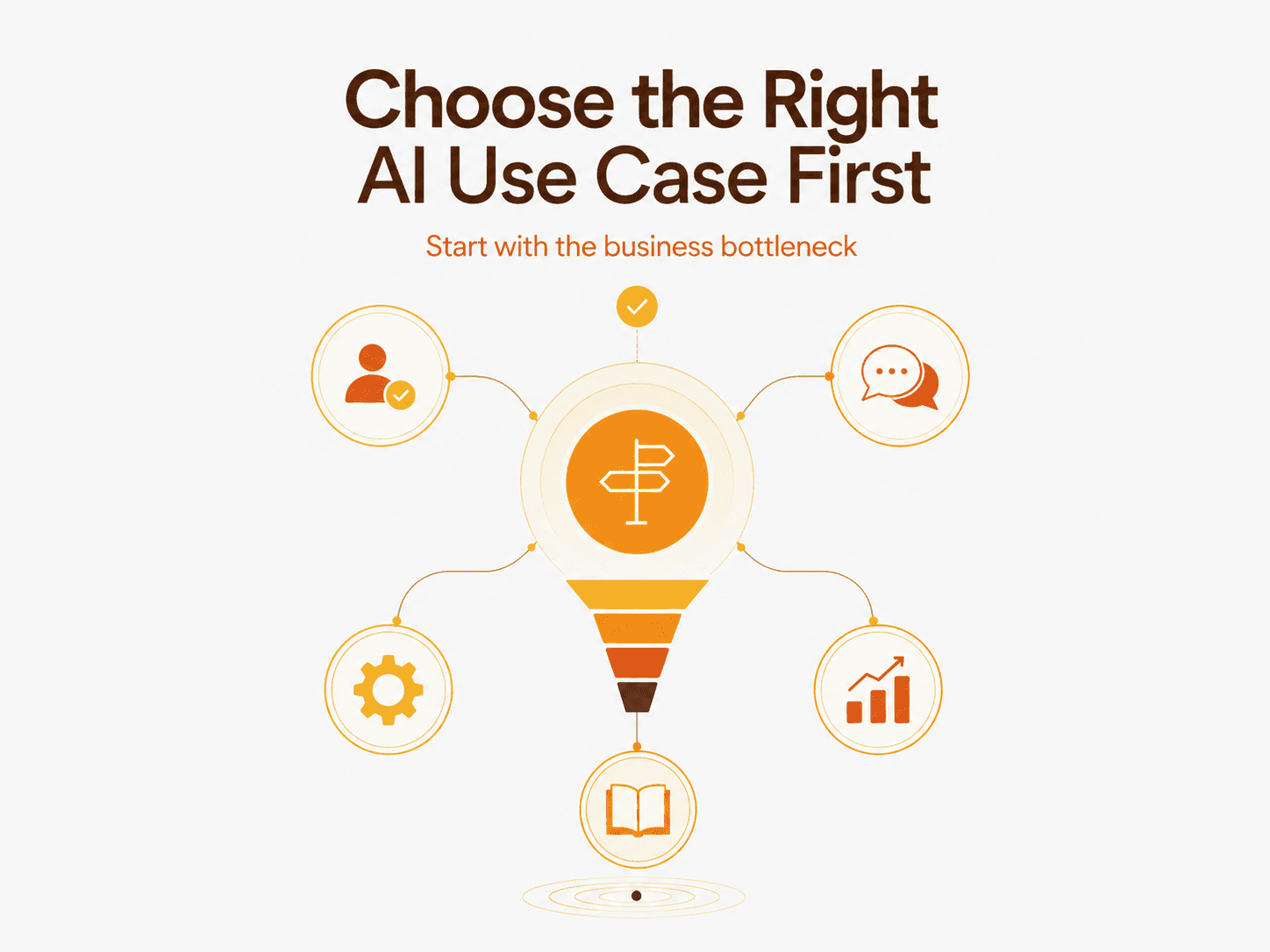
Best AI Use Case for Business Is Not Always the Most Exciting One
Most companies are asking the wrong AI question.
They ask, “What AI agent should we build?”
The better question is, “Which business problem is painful enough, repetitive enough, measurable enough, and safe enough to automate first?”
That difference matters.
A chatbot on your website may look innovative, but if your real leak is slow lead qualification, delayed follow ups, messy CRM data, repeated support tickets, invoice processing, or manual reporting, then the chatbot is not your best first AI use case.
The best AI use case for business is the one that turns a real operational bottleneck into measurable business value.
That is where AI agent development becomes useful. Not as a trend. Not as a fancy demo. As a system that reduces delay, removes manual work, improves decision quality, or helps your team move faster without hiring more people.
Why Most Companies Pick the Wrong AI Use Case
AI adoption is high, but impact is still uneven.
McKinsey’s 2025 State of AI research shows that most organizations now use AI in at least one business function, yet many still struggle to show meaningful enterprise level financial impact.
That tells you something important.
The problem is not lack of AI tools.
The problem is poor use case selection.
Companies usually fail because they start with technology instead of workflow reality. They pick what sounds impressive instead of what is operationally valuable.
Common bad first AI use cases include:
Building a general chatbot without clear customer intent data
Automating a process nobody has measured
Creating AI dashboards that leaders do not use
Connecting AI to sensitive systems before governance is ready
Replacing human judgment in areas where the business still lacks clear rules
This is where business owners need to be honest. If your internal process is broken, AI will not magically fix it. It will expose the mess faster.
The First Rule: Start Where Time, Money, or Revenue Is Leaking
Your first AI agent use case should come from a visible business leak.
Look for places where work is:
Repeated daily
Dependent on copy paste activity
Slowed down by manual follow ups
Based on structured decisions
Connected to revenue, cost, response time, or customer experience
Easy to measure before and after implementation
For example, an AI sales agent that qualifies inbound leads and drafts follow ups can be a stronger first project than a broad AI assistant for the whole company.
Why?
Because sales response time, meeting booking rate, lead quality, follow up speed, and conversion rate can be measured.
That makes the project easier to justify.
Best First AI Agent Use Cases by Business Function
1. AI Lead Qualification Agent
Best for companies getting regular inbound leads.
This AI agent can read form submissions, score leads, enrich basic company data, identify buying intent, draft personalized replies, update CRM fields, and alert the sales team when a lead is worth attention.
Good first use case when:
Your sales team wastes time on weak leads
Good leads are not followed up quickly
CRM data is incomplete
You sell high ticket services
2. AI Customer Support Triage Agent
Best for companies with repeated customer questions.
This agent can classify support tickets, answer common queries from approved knowledge sources, escalate complex issues, summarize customer history, and suggest replies to human support agents.
Good first use case when:
Support volume is growing
Your team answers the same questions daily
Response time affects customer satisfaction
You already have FAQs, SOPs, help docs, or product documentation
Do not fully automate support on day one if your answers require legal, financial, medical, or high risk judgment. Start with draft mode and human approval.
3. AI Operations Workflow Agent
Best for service businesses, agencies, logistics, healthcare operations, and internal teams.
This agent can track task status, chase missing inputs, summarize updates, prepare reports, check documents, and move work between tools.
Good first use case when:
Your team spends hours coordinating work
Tasks get delayed because someone forgot to update a system
Managers keep asking for status reports
Work depends on multiple tools like email, CRM, spreadsheets, Slack, or project management software
This is often one of the highest ROI areas because it removes invisible operational drag.
4. AI Knowledge Base Agent
Best for companies with scattered internal documents.
This agent lets employees ask questions across SOPs, policies, product documents, training material, proposals, and internal notes.
Good first use case when:
Employees keep asking the same internal questions
Information is spread across Google Drive, Notion, PDFs, CRM, and email
Onboarding takes too long
Senior people are interrupted for basic answers
This use case is safer when the agent retrieves from approved company sources and shows references.
5. AI Reporting and Analytics Agent
Best for founders, operators, finance teams, and marketing teams.
This agent can pull data from approved systems, summarize trends, flag anomalies, explain changes, and prepare weekly reports.
Good first use case when:
Reports are manually created every week
Leadership decisions depend on scattered data
People spend more time preparing reports than acting on insights
You need faster visibility into sales, marketing, finance, or operations
Use This Scorecard Before Building Any AI Agent
Before you invest in custom AI agent development, score each possible use case from 1 to 5.
Business value
Will this reduce cost, increase revenue, improve speed, or improve customer experience?
Repetition
Does this task happen often enough to justify automation?
Data readiness
Do you already have the documents, records, systems, or examples needed for the agent to work?
Integration difficulty
Can the agent work with your current CRM, website, email, database, helpdesk, or internal tools?
Risk level
What happens if the agent gives a wrong answer or takes the wrong action?
Measurement
Can you track before and after metrics clearly?
The best first AI use case is not the one with the highest excitement. It is the one with the highest value, high repetition, available data, manageable risk, and clear measurement.
What Metrics Should You Track?
A serious AI implementation roadmap needs numbers.
Track metrics like:
If you cannot measure the workflow before AI, you are not ready to claim ROI after AI.
That is blunt, but necessary.
Where AI Agents Need Human Control
AI agents are powerful because they can observe, plan, and act across tools. That also creates risk.
A support agent that drafts replies is low risk.
A support agent that refunds payments, changes account permissions, or sends legal commitments without approval is higher risk.
A good AI automation services partner will define:
What the agent can read
What the agent can write
What the agent can decide
What requires human approval
What gets logged
What gets reviewed
What happens when confidence is low
This is why AI governance is not optional. NIST and OWASP both make the same point in different ways: AI systems need risk management, access control, monitoring, and protection against misuse.
For business owners, this means one thing.
Do not give an AI agent full freedom before you understand the consequences.
Start with assistive automation. Then move to approved action. Then move to limited autonomy.
A Practical 30 Day AI Use Case Selection Plan
Week 1: Find the business leak
Interview sales, support, operations, and leadership. Ask where time is wasted, where customers wait, where revenue slips, and where manual work repeats.
Week 2: Map the workflow
Document the current process step by step. Identify systems, inputs, decisions, exceptions, and approval points.
Week 3: Score the top use cases
Use the scorecard. Pick one use case only. Avoid the temptation to automate five things at once.
Week 4: Build the pilot plan
Define the success metric, data sources, user group, risk controls, and timeline. Start with a narrow pilot that proves value.
The right first project should be small enough to ship, serious enough to matter, and measurable enough to justify the next investment.
Final Answer: What Is the Best AI Use Case for Business?
The best AI use case for business is usually not a generic chatbot.
For most companies, the best first AI agent use case is one of these:
Lead qualification
Customer support triage
Internal knowledge search
Operations workflow automation
Automated reporting
Pick the one closest to money, time, or customer experience.
If your business has inbound leads, start with an AI lead qualification and follow up agent.
If your team is drowning in repeated customer questions, start with AI customer support automation.
If your operations are slow because humans keep chasing updates, start with AI workflow automation.
If your knowledge is scattered, start with an internal AI knowledge base agent.
The companies that win with AI will not be the ones that build the flashiest demos. They will be the ones that choose the right use case first, measure it properly, and scale only after the workflow proves value.
At Eveningside Labs, we help businesses identify the right AI automation opportunity, design the workflow, build the AI agent, integrate it with existing tools, and measure the impact.
If you are not sure where AI fits in your business, do not start by buying another tool. Start with an AI use case audit.