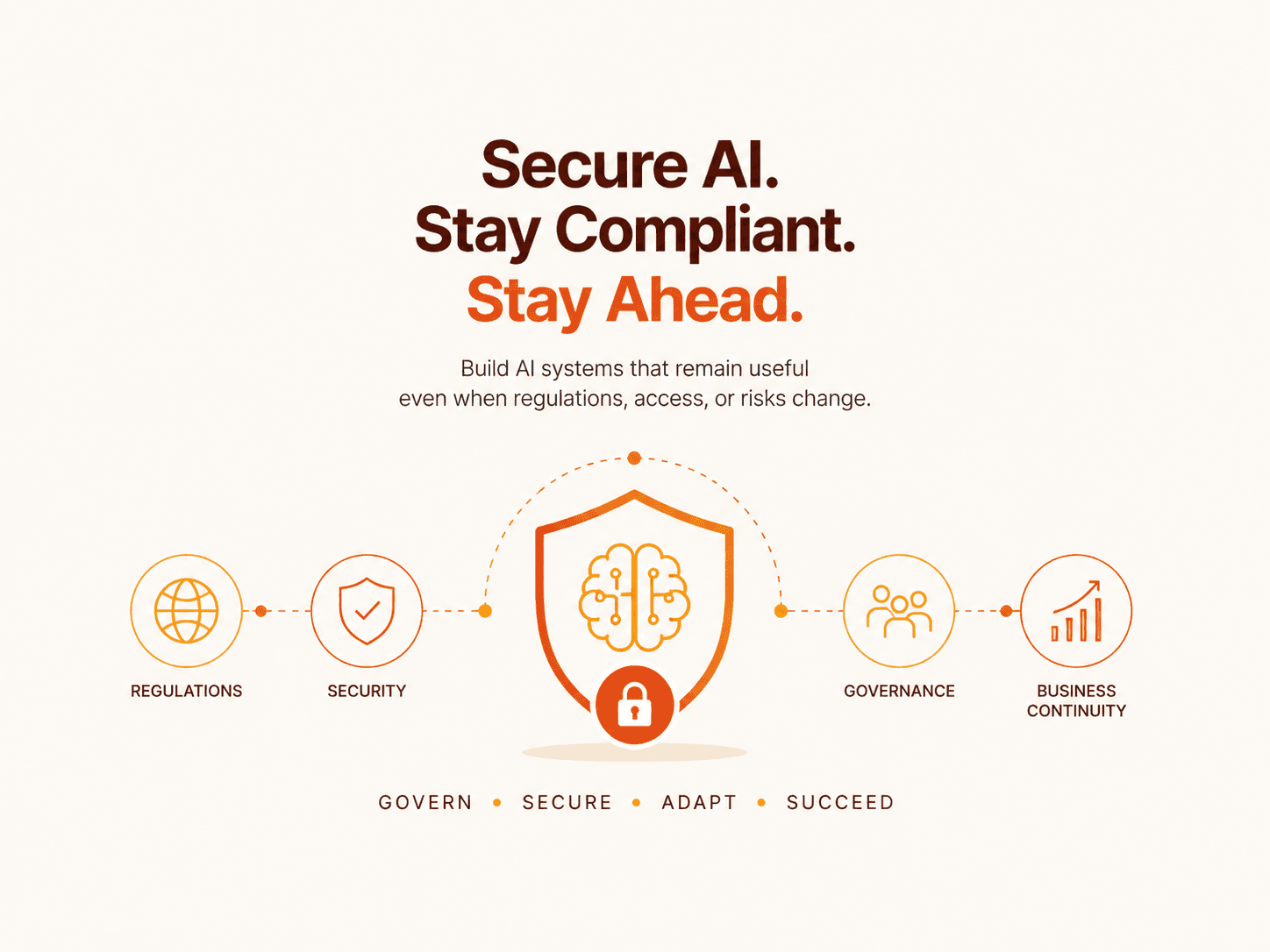
The reported push by the Trump administration to restrict foreign access to Anthropic’s most advanced AI models has turned AI export controls into a boardroom issue.
This is no longer a narrow policy debate about chips, China, or Washington politics. It is about who gets access to frontier AI, who controls cyber capable models, and how businesses should build AI systems when the rules can change quickly.
Anthropic said the US government issued an export control directive requiring suspension of access to Fable 5 and Mythos 5 by foreign nationals, including foreign national employees inside the United States. The company then disabled those models for all customers to comply.
That matters because these models were not just writing assistants. They were reportedly strong at cybersecurity tasks, including vulnerability discovery and exploit analysis. That is exactly why governments are nervous. It is also why cybersecurity experts pushed back.
The uncomfortable truth is simple: the same AI models that can help defenders find and fix security flaws can also help attackers move faster.
What Happened With Anthropic AI Restrictions
Anthropic’s statement said the government directive arrived on June 12, 2026, and did not provide detailed public evidence of the national security concern. The company said it understood the concern involved a possible method of bypassing safeguards in Fable 5.
Anthropic argued the example it reviewed involved known, relatively minor vulnerabilities and that similar capabilities were already available in other public models. It also said its safeguards had been red teamed for thousands of hours with government and third party testers before launch.
The bigger issue is not whether one specific model should have been restricted. The bigger issue is that AI export controls are now expanding from hardware into model access, model weights, deployment rights, and even who inside a company can work with certain systems.
For AI buyers, that creates a new category of operational risk.
You may choose a model today, build workflows around it, train staff on it, connect it to internal tools, and then lose access because of export rules, vendor policy changes, national security reviews, or regional compliance limits.
That is not a technical inconvenience. It is a business continuity risk.
Why Cybersecurity Experts Pushed Back
The backlash from cybersecurity experts was not because they think frontier AI has no risk. That would be naive.
Their argument is sharper: if advanced models are useful for finding vulnerabilities, then blocking defenders from using them may weaken security faster than it limits attackers.
More than 100 cybersecurity experts and industry leaders reportedly asked the US government to lift the restrictions and use a more transparent scientific process for AI risk assessments. Their concern was that adversaries are already moving fast, and defensive teams need the best available tools to keep up.
This is the core policy tension.
Restricting access may slow misuse by some actors. But it may also reduce the ability of companies, auditors, researchers, and security teams to test systems before attackers do.
That is why broad AI restrictions can backfire if they are not precise.
Good controls should focus on risk, capability, end user, use case, monitoring, and accountability. Bad controls simply remove useful tools from trusted defenders while motivated attackers shift to other models, open source systems, stolen credentials, or local alternatives.
AI Export Controls Are Moving Beyond Chips
For years, the AI export control conversation focused mainly on advanced semiconductors and compute infrastructure. The logic was clear: if a country cannot access the best chips, it becomes harder and more expensive to train frontier models.
The 2025 AI Diffusion Framework went further by addressing advanced computing clusters and certain closed model weights. The Trump administration later moved to rescind the Biden era diffusion rule, saying it was too burdensome and could harm US innovation and diplomatic relationships.
But the Anthropic case shows that model level control has not disappeared. It has become more targeted, more political, and more immediate.
That creates a difficult environment for global companies.
A business in India, the UAE, Europe, Australia, or Canada may use American AI models for customer support automation, internal knowledge systems, software testing, compliance review, marketing automation, or AI enabled SaaS products. If model access becomes fragmented by nationality, region, sector, or security classification, companies need AI architecture that can survive provider disruption.
This is where most businesses are underprepared.
They are building AI workflows like a single vendor will always be available, always be legal, always be affordable, and always be allowed in every country where they operate.
That assumption is weak.
What This Means For Businesses Using AI
If your company is building with AI, the Anthropic restrictions should push you to ask five practical questions.
1. Are we dependent on one frontier model?
A single model dependency is fragile. Your AI stack should support fallback models, alternate providers, and task specific routing. Not every use case needs the most powerful model. Many customer support, document processing, lead qualification, internal search, and workflow automation tasks can run on smaller, cheaper, safer models.
2. Do we know where our AI data goes?
AI export controls are not only about model capability. They also raise questions about data location, user nationality, vendor infrastructure, and access rights. If your AI system handles customer data, financial records, healthcare information, legal documents, or proprietary code, you need clear data governance.
3. Have we separated low risk automation from high risk decisions?
A chatbot answering product FAQs is not the same as an AI agent approving loans, handling medical advice, screening job applicants, or scanning production code. High risk systems need stronger review, logging, access control, human oversight, and incident response.
4. Can we prove our AI system is safe enough?
Enterprise buyers increasingly want evidence. That means model cards, risk assessments, evaluation reports, red team testing, prompt injection testing, audit trails, and clear human escalation paths. Trustworthy AI is becoming a procurement requirement, not a branding slogan.
5. Are we using AI defensively?
The Five Eyes cyber agencies warned that frontier AI will transform both offensive and defensive cyber capabilities within months, not years. Businesses should not wait for perfect regulation. They should use AI to improve vulnerability detection, software testing, monitoring, incident response, and security documentation now.
The Real Lesson: AI Governance Is Becoming A Competitive Advantage
The wrong takeaway is “avoid AI because regulation is risky.”
That is lazy thinking.
The right takeaway is “build AI systems with governance from day one.”
Businesses that treat AI governance as paperwork will move slowly. Businesses that treat it as engineering will win.
Good AI governance means:
Clear use case selection
Secure AI architecture
Data minimisation
Vendor risk review
Human oversight for sensitive decisions
Testing for hallucination, prompt injection, and misuse
Monitoring after deployment
A fallback plan if model access changes
This is especially important for companies using AI automation, AI agents, custom AI software, AI SaaS platforms, AI chatbots, AI API integration, and model fine tuning.
The companies that will benefit most from AI are not the ones chasing every new model release. They are the ones building resilient systems around real business problems.
What Eveningside Labs Recommends
At Eveningside Labs, we believe businesses should stop treating AI as a plug in tool and start treating it as critical infrastructure.
If you are building AI into customer support, operations, sales, marketing, software testing, compliance, data workflows, or SaaS products, your system should be designed for performance, security, compliance, and continuity.
That means your AI roadmap should include:
1. AI readiness audit
2. Secure model selection
3. Multi model architecture
4. Data protection strategy
5. Workflow automation blueprint
6. LLM security testing
7. Human in the loop review
8. Compliance documentation
9. Post deployment monitoring
This is not overengineering. This is what serious AI adoption now requires.
The Anthropic AI restrictions are a warning shot. Frontier AI access can become a national security issue overnight. If your business depends on AI, you need an implementation partner who understands automation, software architecture, model integration, security, and responsible AI deployment.
Final Takeaway
AI export controls will not stop AI adoption. They will change how serious companies adopt AI.
The future belongs to businesses that can use frontier AI without becoming fragile, dependent, or exposed.
For leaders, the question is no longer “Should we use AI?”
The better question is:
Can our AI systems keep working if regulation, model access, cybersecurity threats, or vendor policies change tomorrow?
If the answer is no, the risk is already inside your business.
Eveningside Labs helps businesses build secure AI automation, AI SaaS products, custom AI systems, AI agents, and model integrations designed for real business outcomes. Book a free AI audit to identify where AI can save time, reduce cost, improve operations, and strengthen your competitive edge.